
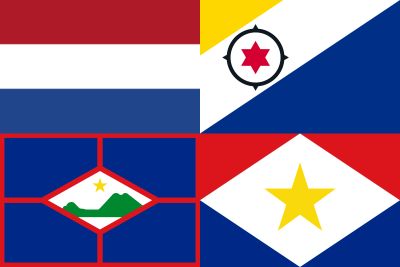
The Caribbean Netherlands — or the BES islands — is a collective region of the Netherlands in the Caribbean, consists of three special municipalities: Bonaire, Sint Eustatius and Saba. Once part of the Netherlands Antilles, along with Sint Maarten, Curaçao and Aruba, the three islands became special municipalities after the dissolution of the Antilles in 2010 when Aruba came an constituent country within the Kingdom of the Netherlands in 1986, followed by Sint Maarten and Curaçao in the year of the dissolution.
Bonaire lies in the Southern Caribbean Sea, east of Curaçao. It is the largest island of the three, known for its turquoise waters, coral reefs and excellent diving and snorkelling, along with having a dry, semi-arid landscape with cacti, salt flats and flamingos, and a strong economy thanks to marine tourism. Its capital, Kralendijk, is the principal town and administrative centre of Bonaire, with a waterfront promenade possessing colourful buildings, local shop and restaurants, the historical site Fort Oranje, and a scenic marina. Even though the Caribbean Netherlands itself doesn't have a single capital, Kralendijk is widely considered as the main administrative hub of the region.
Sint Eustatius — often called Statia — is a small volcanic island in the Northeastern Caribbean sea. Despite its size, it played an important role in Caribbean commerce during the 17th and 18th centuries. Today, it is known for its volcanic scenery — The dormant volcano known as The Quill in the southeast, historical ruins, archaeological sites and relatively a quiet atmosphere. Its capital, Oranjestad, is the main settlement on the island, and is a historic harbour town that's divided into two main sections; a lower waterfront part which borders on Sint Eustatius' safest beach, and a restored historic upper part that is the island's main commercial and residential centre.
And Saba is the smallest island of the collective, situated northwest from Sint Eustatius. The island is renowned for its steep volcanic terrain and lush mountainous landscape, with Mount Scenery reaching about 887 metres, making it the highest point in the Kingdom of the Netherlands. The island is also popular for hiking, diving, and nature tourism. Its capital, The Bottom, is Saba's administrative centre. Despite its name, the settlement is situated in a valley high above the coast, surrounded by steep green hills, and containing government offices, shops, restaurants, and other essential services.
Tropical cyclones, sea-level rise, earthquakes and severe droughts.
For driving/traffic offences;
Other violations to keep in mind;
The official language of the Caribbean Netherlands is Dutch, while English is spoken in Saba and Sint Eustatius, and Papiamentu is spoken in Bonaire.
Vehicles drive on the right on the islands, but turning right on a red light is not allowed. The minimum age to drive is 18, but to rent is 21 – 23, depending on the rental company. Many rental companies would drivers to have held a valid licence for at least 1 – 2 years, and would apply a young driver surcharge or vehicle category restrictions to those under 25. UK drivers are not legally required to have an International Driving Permit (IDP) on the islands, but having one is strongly recommended for local police stops and if your rental company requests one.
Road conditions in the Caribbean Netherlands are different between the islands. Roads in Bonaire are generally flat, open and easy to navigate, but be cautious for any pedestrians, cyclists and free-roaming wildlife (e.g., donkeys and goats) as you drive. Also, there are no traffic lights on the island, and traffic is typically light and relaxed. As for Saba and Sint Eustatius, roads are steep, narrow, uneven and feature sharp switchbacks, with Saba — being extremely mountainous — having an notorious cement road, with many sharp bends and steep sections, that connects the airport to the harbour as the island's main road. The road goes by the nickname: "The Road That Couldn't Be Built" (or simply; 'The Road'). In addition; a large portion of Sint Eustatius' roads also suffer from faded markings and limited lighting, and heavy rains can quickly trigger rockfalls, debris slides and localised flooding on the steep hillside roads of Saba.
A rental car is strongly recommended since public transport on all islands are extremely limited or non-existent, and attractions are spread across the municipalities. A pickup/SUV is strongly advised if you attend to explore unpaved roads or carry diving equipment.
Petrol and diesel are available in all three islands — with Bonaire selling Mogas 95 (95-octane unleaded), premium/high-octane petrol and low-sulphur diesel, but EV charging is more limited than conventional fuel, and is mainly available in Bonaire, while no public charging access currently exist on Sint Eustatius and Saba. Fuel stations are generally self-service in Bonaire — you fill up yourself and then pay at the counter or kiosk, while in Sint Eustatius; you state to an attendant or cashier how much fuel you want, pre-pay at the counter, then the pump becomes activated for you, and in Saba; you arrange payment at the desk or window, pre-pay, and then an attendant will either fill up the vehicle or unlock the pump for you to use. Card is accepted as payment, but it is best to carry cash as backup.
There are 6 known fuel stations across the Caribbean Netherlands; 4 in Bonaire (3 in Kralendijk, 1 in Rincón), one at Faeschweg in Oranjestad, and one at Fort Bay in Saba. Not all stations operate 24/7, but the Curoil Gas Station in Kralendijk runs a 24/7 Automated fuelling system. Bonaire's stations typically run 7am – 7/10pm, the station in Sint Eustatius is open 7am – 5/9pm, and the station in Saba operates 7am – 12pm, then reopens 1pm – 4pm. Bonaire's and Sint Eustatius' stations have reduced hours on Sundays, but Saba's station has reduced hours on Saturdays, and is closed on Sundays. If you are planning to explore across one of the islands, make sure to top-up early as fuel shortages can occur, and don't let the tank run too low.
The BAC limit is 0.05%, matching Dutch limits.
Mandatory for all occupants.
In Bonaire, children under 3 years must be secured in an approved child safety seat or booster seat, while children under 150cm tall must wear a lap belt or a restraint system. As for Saba and Sint Eustatius, children under 4 must be in an child safety or booster seat, with the rule also applying to children under 130cm tall in Saba. Under 12s must ride in the back seats for all islands.
Though not universally mandatory, a rental company may provide their vehicles with the following items:
Check out more of our Country Guides: