
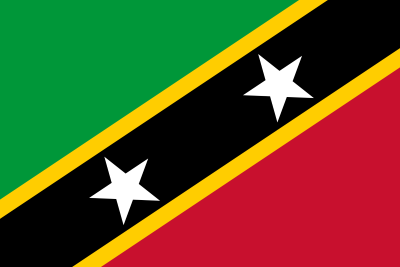
Officially known as the Federation of Saint Christopher and Nevis, Saint Kitts and Nevis is a two-island country in the eastern Caribbean Sea, part of the Lesser Antilles. Once was an associated state of the United Kingdom until 1983, it is the smallest sovereign state in the Western Hemisphere by both area and population, where the islands of Saint Kitts — also called Saint Christopher — and Nevis are separated by a narrow channel known as 'The Narrows'. The country is known for its volcanic mountains, lush tropical forests, black and white sand beaches, coral reefs and marine life, historic colonial architecture and forts, a relaxed Caribbean culture with music such as calypso and soca, and the Brimstone Hill Fortress National Park — the nation's most famous landmark and a UNESCO World Heritage Site.
Its capital, Basseterre, is located on the southwestern coast of Saint Kitts. Founded 1627 by the French, the city is one of the oldest towns in the eastern Caribbean, and it serves as the country's administrative, commercial, and main port centre. Basseterre features colonial buildings, Independence Square — a historic public park, St. George's Anglican Church and Port Zante — the primary gateway for cruise tourism and a hub for shopping, leisure and maritime services.
Hurricanes and tropical storms, along with hurricanes, tropical cyclones, volcanic activity, coastal flooding, earthquakes and landslides.
For traffic/driving violations;
Other offences to keep in mind are:
The official language of Saint Kitts and Nevis is English, but Saint Kitts Creole is also spoken.
Vehicles drive on the left in St. Kitts and Nevis. The minimum driving age is 16, but the minimum renting age is 21 – 25, depending on the rental company. Some of these companies would charge a 'young driver' surcharge to those under 25, and would not allow their cars to travel between St. Kitts and Nevis via ferry, so check in advance. UK drivers are not legally required to have an International Driving Permit (IDP) if they have a valid UK photocard licence, but you must purchase a local temporary driving licence/permit, which would cost about EC$62.50 (~£17). Most rental companies arrange the permit for you at pickup.
Roads are generally paved but can be narrow, winding and poorly lit at night, alongside having steep hills, wandering goats, dogs and chickens, occasional aggressive local driving, potholes and speed bumps. make sure to drive slowly in villages, be careful at roundabouts, keep an extra distance from vehicles in front, and avoid driving at night.
Most fuel stations in the country sell unleaded petrol, diesel and LPG. Many stations still use attendants that would fill up for you, and most larger ones accept cash (Eastern Caribbean dollar and US dollar) and card, but smaller stations may only accept cash, so carry some as backup. Keep in mind that fuel is relatively expensive because it is imported. Government-regulated maximum fuel prices are published periodically, where, in May 2026, unleaded petrol would cost around EC$18 (~£5) per imperial gallon (~4.55 litres).
Both islands have regular petrol stations, especially around Basseterre, Frigate Bay, Sandy Point and Charlestown, where many are open between 7am to 9/10pm, but stations in rural areas may close earlier on Sundays, and stations near Basseterre are open 24/7. As you travel across St. Kitts, you may encounter greater fuel consumption than expected due to steep hills, stop-start village traffic and air-conditioning use in tropical heat. Even though driving around the islands would only take a few hours, it is advised to fill up before departure, and don't assume every station will be open late, especially on Nevis.
The legal limit is 0.08%.
Seat belts are mandatory.
Children under the age of 5 must be secured in an appropriate child car seat.
Check out more of our Country Guides: