
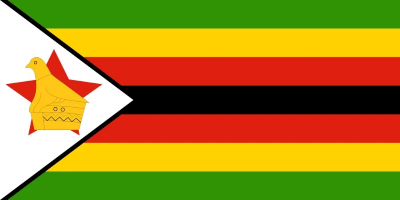
Zimbabwe (officially; the Republic of Zimbabwe) is a landlocked nation in Southeast Africa, bordered by Zambia to the north, Mozambique to the east, South Africa to the south, and Botswana to the west. The country is known for its varied landscapes, which include savannas, plateaus, rivers, and mountains, as well as famous natural sites like Victoria Falls (one of the largest waterfalls in the world) and Hwange National Park (home to diverse wildlife). Zimbabwe has a rich cultural history shaped by ancient civilizations such as Great Zimbabwe, whose stone ruins gave the country its name. The economy is largely based on agriculture, mining and tourism, and the country is very multilingual, with Shona and English being official languages.
The capital of Zimbabwe is Harare. Located in the northeastern part of the country, Harare is the country's largest city and serves as its main political, economic, and cultural centre. The city is known for its relatively mild climate, tree-lined streets, markets, and institutions such as universities, government offices, and businesses, with it playing a key role in trade, industry, and transportation within Zimbabwe.
Droughts, floods (riverine & flash), and tropical cyclones.
Zimbabwe uses a 'standard scale of fines' system where offences are assigned a level (1 – 14) where a higher fine is paid, the higher the level (in USD: Level 1 = $5, Level 14 = $5,000). For traffic and driving offences, Zimbabwe uses a Traffic Schedule of Deposit Fines that police can apply for certain offences. On-the-spot fines are issued for minor offences, which are handled at police stations, whereas more serious or contested offences are handled at the magistrates’ court by a judge. Police cannot legally impose on-the-spot fines higher than the level allowed (currently around Level 3 = $30) — amounts beyond that must be determined by a court.
Penalties for traffic and driving offences include (in USD);
Other offences to keep in mind are:
Zimbabwe has 16 official languages, including Shona, Ndebele, Tswana and English.
Vehicles drive on the left side in Zimbabwe. The minimum driving age is 16, but the minimum renting age is 22 with the requirement of held a valid licence for at least 1 – 2 years. Many rental companies would often charge extra on drivers under 25. UK drivers are required to have an International Driving Permit (IDP) to drive legally in Zimbabwe, along with their valid licence.
The roads on major highways are mostly paved but can have potholes, faded markings and unreliable lighting, where as secondary and rural roads are often gravel and rough, which the condition can worsen in rain. Also; many roads would have unmarked speed bumps and/or non-working traffic lights, expect unpredictable local driving behaviour and police checkouts, do not drive at night due to poor lighting with wildlife, pedestrians, livestock and unlit vehicles posing risks, and slow down when wildlife cross roads near parks and reserves.
Only ethanol-blended unleaded petrol (E10 – E20) is available in Zimbabwe, along with Diesel 50 (low-sulphur) and Diesel 500 ppm. Fuel stations are usually attendant-served, so don't self-pump. Cash is widely accepted, but card is not accepted at many stations due to cash-oriented systems. Also, some stations would prefer USD cash over Zimbabwe Gold because of inflation and local currency challenges.
Fuel stations are available across towns and cities (like Harare and Bulawayo), and on major highways. However, stations can be scarce in remote and rural areas, though the Zimbabwean government has been encouraging low-cost, containerised fuel outlets in underserved regions to improve access. It is strongly recommended to top up before long journeys and whenever possible, and avoid buying black-market fuel on the streets since they are usually sold informally in containers which can be unsafe and may damage your vehicle.
The BAC limit is 0.08%.
Compulsory for all occupants.
It is recommended for children under 12 or 135cm to be in an approved child restraint, but it is required by law that children under 12 or 135cm are not allowed to sit in the front seat unless they're in an approved child restraint.
Check out more of our Country Guides: