
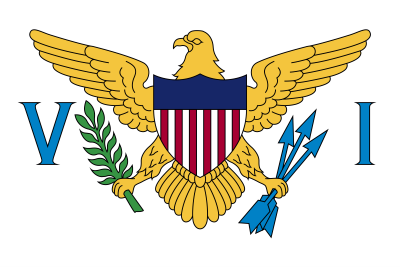
Known as the Virgin Islands of the United States, the US Virgin Islands are an unincorporated territory of the United States of America located in the Caribbean Sea, east of Puerto Rico. It consists of 4 main islands; St. Thomas, St. John, St. Croix and Water Island, along with 50 other islets and cays, and the territory is known for its tropical climate, white-sand beaches, coral reefs, and lush hills, which all together, makes tourism a major part of its economy. Even though the residents of the US Virgin Islands are US citizens, they cannot vote in the US presidential elections unless living on the mainland.
The capital of the US Virgin Islands is Charlotte Amalie, located on the island of St. Thomas. It is one of the oldest cities in the Caribbean, dating back to 1671 when it was founded by the Danes, and it is famous for its deep natural harbour, historic Danish colonial architecture, and vibrant shopping districts. The city serves as the political and economic centre of the islands, and is a popular stop for cruise ships visiting the Caribbean.
Hurricanes, tropical storms, flooding, landslides and droughts, alongside earthquakes, tsunamis and mosquito-borne diseases.
For traffic and driving offences;
Unpaid fines can lead to collections, vehicle holds, or complications if you return later. Other offences to keep in mind are:
Penalties for fishing violations can also include suspension of fishing permits.
The official language of the US virgin islands is English, but Virgin Islands Creole is also spoken.
In the USVI, vehicles drive on the left side, though most rental companies would rent out cars imported from the US — cars with the steering wheel on the left. The minimum age to drive is 18 years, but the minimum age to rent is generally 25, but some companies allow 21s and older, with type restrictions and 'underage' fees for under 25s in placed. UK drivers don't need an International Driving Permit (IDP) with their valid licence to drive in the US Virgin Islands, unless you have an older paper licence, staying in the USVI for over 90 days, or the rental company you're using requires it.
Roads, especially outside main towns, can be narrow, winding and hilly in the USVI, with potholes, minimal lighting and road signs, and animals crossing. Therefore, it is advised to avoid driving at night, especially if you're uncomfortable driving in a left-hand drive car. Also, a quick horn 'beep' is often used courteously (e.g., saying thanks).
Regular unleaded (87 octane) is the most common fuel type and is widely available, where premium (91 - 93 octane) is available too, but less common, diesel only available at selected stations, and EV charging mostly near major towns or resorts. Many stations, on St. Thomas and St. John, offer full service, where self-service pumps are available too, especially on St. Croix. Payment is done at the cashier inside the station before or after fuelling, rather than using a 'pay-at-pump' system — especially at unattended pumps, and carrying cash can be helpful in less busy stations that may prefer or require it.
Stations are available on all main islands, but there are only a few stations on St. John, and outside main urban areas are very sparser. In addition, some smaller stations have limited hours, so keep your tank at least half-full in rural areas, and top-up whenever the opportunity arise earlier in the day, not late in the afternoon.
For general guidelines;
But for exceptions;
The legal limit is 0.08%, though you can be charged if impaired, even below 0.08%.
Mandatory for all passengers.
Children under age 8 or 4'9" (145cm) tall must ride in a proper car seat or booster seat. Children under 14 should always sit in the back.
Check out more of our Country Guides: