
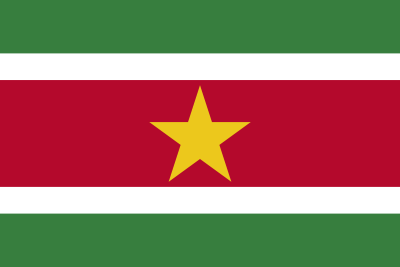
Suriname, or known officially as the Republic of Suriname, is a country on the northern coast of South America, bordered by Guyana, French Guiana and Brazil, along with the Atlantic Ocean. Once was a constituent country of the Kingdom of the Netherlands until it gained complete independence in 1975, Suriname is known for being the second-highest territory in the world to be covered the most by forest, and a developing country with an economy dependent on mining (gold), agriculture, oil, forestry and services, alongside a highly diverse culture with African, Indian, Javanese, Indigenous, Chinese, European and other influences, which is reflected in Suriname's languages, food, music and religious traditions.
Its capital, Paramaribo, is the largest city in the country, and its main political, economic and cultural centre. Situated along the Suriname River near the Atlantic coast, Paramaribo is known for its historic inner city, where Dutch colonial architecture stands alongside buildings and cultural influences from Suriname's diverse population. The city is also an important commercial hub with markets, shops, restaurants, government buildings and cultural institutions.
Coastal and river floods, rising sea levels, landslides and intense droughts.
For driving/traffic offences;
For an ordinary traffic violation, police can issue a fine, which payment can be made immediately to the officer directly — which they would provide a receipt, or through a formal report/process-verbal, with payment subsequently made at the Parketwacht (Police/Prosecution Guard Department) in Paramaribo before the court date. Failure to pay a fine can result in being summoned before the Kantonrechter (cantonal court), and drivers with outstanding traffic fines can be detained during traffic checkpoints, potentially resulting in detention.
Other offences to keep in mind are:
The official language of Suriname is Dutch, but Sranan Tongo, along with Indigenous and several other languages, are also spoken.
Vehicles drive on the left side of the road in Suriname. The minimum driving age is 18, while the renting age is 21, though drivers under 25 commonly face an extra daily young-driver fee, and most rental companies require drivers to have held a valid licence for at least one year. UK drivers are required to have an International Driving Permit (IDP), alongside their UK driving licence, to drive and rent in Suriname, and must carry both while driving at all times.
While the conditions of the main roads in Paramaribo are usually well-paved, secondary roads, alongside roads outside the capital, are poorly maintained with potential potholes, uneven surfaces, narrow lanes, poor lighting, no markings or risks of localised flooding during heavy rains. Roads outside the coastal plain can become dirt tracks through rainforests, which would require high-clearance vehicles to drive through, and bridges in remote areas tend to be in disrepair. Watch out for unexpected pedestrians, cyclists and stray animals on the road, and try to avoid night driving as possible, particularly outside urban areas.
The main types of fuel tourists encounter at Surinamese petrol stations are unleaded petrol (benzine/95 RON), premium petrol (super unleaded) and diesel (including ultra-low-sulphur). Most stations are attended where someone fills up for you, and some modern stations — like GOw2 brand stations — would accept card payments, but stations outside Paramaribo are much less dependable on card acceptance. It is advised to carry cash with you, but be careful as not every ATM would accept foreign Visa/Mastercard cards, so don't wait until you're nearly empty before getting cash.
Stations are more frequent in urban areas like Paramaribo and Nieuw Nickerie, but are more sparse in remote and rural areas. If you are planning to travel to remote areas, make sure to top-up beforehand, not let your tank run too low, and fill up whenever the opportunity arises.
The BAC limit is 0.05%.
Mandatory for all occupants.
Children 8 years or younger must use an appropriate child restraint or car seat while traveling in a moving vehicle. Infants and toddlers who weigh under 40 pounds typically need to be secured in a rear-facing seat.
Though not required, it is recommended to carry the following items in your vehicle:
Check out more of our Country Guides: