
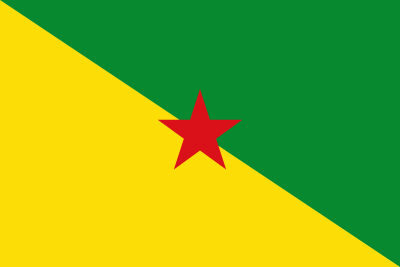
French Guiana — also known by its French name Guyane or Guyane française — is an overseas department and region of France on the northern coast of South America, bordered by Suriname to the west and Brazil to the south and west. The region is the second-largest territory of France, and is the top territory covered the most by forest (about 96%), where most of the population live on a narrow coastal plain at the north. French Guiana is known for the Guiana Space Centre at Kourou — a major European space-launch facility, and its economy relies on services, fishing, gold mining and the space industry.
Its capital, Cayenne, situates on the Atlantic coast, southeast of Kourou, and it's not only the largest city of French Guiana, but the main administrative, commercial and cultural centre of the region. The city is known for its Creole and French colonial heritage, colourful markets, tropical climate and historic buildings like the French Guiana Prefecture Building and Fort Cépérou.
French Guiana faces high risks from river and coastal flooding, heavy rainfall and rising sea levels, alongside wildfires, medium risks of earthquakes and landslides, and low threats from tropical cyclones.
As a overseas department of France, French road-traffic rules apply, including the standard French demerit point system. Every licence starts with 12 points — 6 points for new drivers, where 2 points are gained each year over three years upon reaching the maximum of 12 — and when a drivers commits a traffic offence, points would be reduced. If a driver's point balance becomes depleted, their licence becomes invalidated — resulting them to stop driving in French Guiana entirely.
Common traffic offences include:
Fines for most traffic violations can be reduced if paid within 15 days (or 30 days for electronic payment of mailed notices), but if fines hasn't been paid after 45 days (or 60 days for electronic payments), they would increase significantly.
Other violations to keep in mind are:
The official language of French Guiana is French, but French Guianese Creole, along with Amerindian and Maroon Creole languages, are also spoken.
Like mainland France, vehicles drive on the right. The minimum driving age is 18 years, but it is 21 to rent. Rental companies usually require drivers to have held a valid licence for at least 1 – 3 years, depending on the company, along with applying restrictions on premium or luxury vehicles, and/or a daily young driver fee to drivers under 25. UK drivers don't legally need an International Driving Permit (IDP) to drive in French Guiana, unless they hold an older paper licence or the rental company requires one.
Major roads in French Guiana are generally paved, well-maintained and completely toll-free. However, the conditions outside of main roads conditions can become more difficult to traverse (e.g., inadequate lighting and poor road signage), especially during heavy rain which can severely reduce visibility and rapidly produce potholes. If you planning to travel to or through more remote areas, particularly towards places like Kourou, Saint-Laurent-du-Maroni or Cacao, a 4x4 vehicle is highly recommended. Also, make sure to be extra cautious driving while night, especially outside urban areas, and watch out for gendarmerie checkpoints along the RN1 highway.
The common fuel types in French Guianese petrol stations are SP95 (unleaded petrol), SP98 (premium petrol) and diesel, and fuel prices are regulated, making them relatively consistent between stations. Many stations offer attended service during standard business hours (typically 7am – 7pm) while having 24/7 automated self-service pumps. Payment can be made via a cashier during business hours or directly at the pump with a chip-and-PIN card. Most larger stations accept international cards, but card acceptance can vary, particularly at unattended pumps, so carry some cash as backup.
Fuel is widely available in the main populated areas, particularly around Cayenne, Remire-Montjoly and Saint-Laurent-du-Maroni, but don't expect every town will have a fuel station. If you are planning a long journey, make sure to fill up beforehand and to not let your tank run too low. If travelling into remote/inland areas, consider carrying sufficient fuel in an approved fuel container where appropriate.
The legal limit is 0.05%; 0.02% for drivers who have held their licence for under three years.
Mandatory for all occupants.
Children under 10 years or under 135cm tall must be seated at the back, using an approved child restraint system. Children can sit in the front passenger seat only if they're secured in an appropriate rear-facing or forward-facing seat, the rear seats are all occupied by other children under 10, or there are no rear seats at all.
Though not required, the following items are recommended for long journeys, especially due to French Guiana's tropical climate and long distances between locations;
Check out more of our Country Guides: