
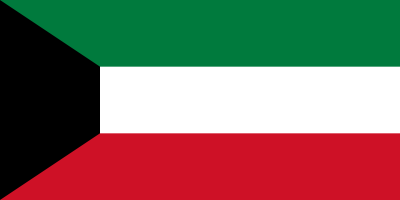
Officially known as the State of Kuwait, Kuwait is a small country in West Asia, situated at the head of the Persian Gulf in the northern edge of the Arabian Peninsula. While the country is mostly desert with a hot climate — very warm summers and mild winters, Kuwait is known for its large oil reserves, which play a major role in its economy and have helped make it one of the wealthier countries in the region. Like most other Arab states of the Persian Gulf, Kuwait is an emirate, whose monarchy dominates Kuwait's political system.
Its capital, Kuwait City, is the largest city in Kuwait, and the main hub for the nation's government, business, and culture. Located on the coast of the Arabian Gulf, the city is famous for its modern skyline (especially its national symbol: the Kuwait Towers), along with having a combination of modern buildings, shopping malls and offices, with traditional markets (souqs) and historic mosques. It is also the main port and transportation hub of the country.
River and coastal floods, as well as extreme heat, and water scarcity.
For driving/traffic offences;
In some cases, vehicles may be impounded, especially for repeated or serious violations.
And for other offences;
The official language of Kuwait is Arabic, but English is also spoken.
Vehicles drive on the right side of the road. The minimum age to drive is 18, but the minimum age to rent a car is 21, though some rental companies may restrict certain cars to drivers at least 25 years, and would apply a young driver surcharge to those under 25. UK drivers do generally need an International Driving Permit (IDP) in Kuwait (especially for longer stays or have an older paper licence), as it's necessary for most rental companies and police checks.
Major highways and ring roads are usually well-paved with clear markings and multi‑lane layouts. However, secondary and local roads around cities and suburbs may be less well‑maintained with uneven surfaces, potholes and cracked asphalt, and some older or rural routes may not always have clear lane markings, and maintenance can lag, especially after heavy weather.
Local driving behaviour is often described as assertive. Drivers would perform sudden manoeuvres, high speeds on open roads, and frequent lane changes, which can be challenging for tourists. Always drive defensively — keep an extra distance between vehicles, and stay alert for sudden manoeuvres.
Premium 91 (standard), Super 95 (mid‑grade), Ultra 98 (high octane) and diesel are the most common fuel types available in Kuwait. Most fuel stations accept cash, where card is usually accepted at larger or branded stations, but not guaranteed everywhere. Some pumps or small stations favour local debit systems (e.g., K‑Net) or cash. Most stations are full-service. So if card is accepted, the attendant will usually handle the payment — so you don’t pump yourself. Stations are are widespread in Kuwait City, Salmiya, Hawalli and along main highways, with many of them (especially on main roads) are open 24/7.
Zero tolerance — alcohol is largely illegal in Kuwait.
Seat belts are mandatory for all front passengers.
Children under 10 are not permitted to sit in the front seat, and that they must use appropriate child restraints (especially those up to 4 years old). Additionally, leaving a child under 10 alone in a vehicle is illegal.