
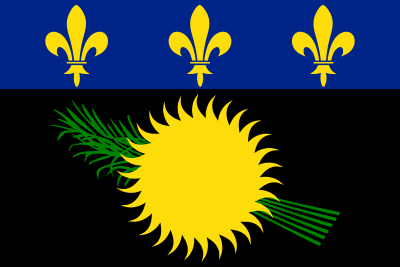

Guadeloupe is a French overseas archipelago in the Caribbean. It is part of the Lesser Antilles and consists mainly of two large separate, yet connected islands: Basse-Terre and Grande-Terre, along with several smaller islands such as Marie-Galante, La Désirade, and Les Saintes. The archipelago is known for tropical rainforests, waterfalls, and volcanic landscapes, along with white and black sand beaches, a creole culture, blending French, African, Indian and Caribbean influences, and its cuisine, featuring dishes like accras and colombo. Guadeloupe's economy relies on tourism, agriculture — especially bananas and sugar cane, and services.
Its capital, Basse-Terre, is situated on the southwestern coast of Basse-Terre Island. Despite being smaller than some other towns in Guadeloupe, it serves as the administrative centre of Guadeloupe, and is well-known for colonial-era architecture, colourful markets, nearby rainforest and waterfalls, and views of La Grande Soufrière — an active volcano and the highest peak in the Lesser Antilles. The largest urban area, however, is Pointe-à-Pitre — located on the southwestern coast of Grande-Terre Island, which functions as the main economic and commercial hub of Guadeloupe.
Hurricanes, active volcanic activity from La Soufrière, earthquakes, tsunamis, landslides and floods.
Guadeloupe follows the same road-traffic laws in France, and enforcement is quite active. Though the territory uses a penalty point system, non-French licence holders won't gain any points when they commit a offence, but that doesn't mean they are immune to fines and other penalties. Common offences that tourists can be fined for are the following:
Other offences to keep in mind;
The official language of Guadeloupe is French, but Guadeloupean Creole and English are also spoken.
Vehicles drive on the right, and road signs follow French/European standards and are mostly in French. The minimum age to drive is 18, but to rent, you typically have to at least 21 and have held a valid licence for at least 1 – 2 years. Most rental companies may charge drivers under 25 a daily 'young driver' surcharge, and may restrict premium/luxury cars to those at least 25 – 28 years old, depending on the company. Automatic cars are available but often cost more than manual transmissions. UK drivers don't generally need an International Driving Permit (IDP) unless they hold an older paper licence, a licence issued in Gibraltar, Guernsey, Jersey or the Isle of Man, or the rental company requests one. When you do rent a vehicle, be sure to check tyre and windscreen cover carefully, take a photo of the vehicle before departure, and confirm whether roadside assistance is included.
Road conditions on the two main islands differ from each other; Grande-Terre has flatter roads and a easier driving experience — which makes it better for beach-hopping and resort areas, but Basse-Terre has mountainous terrain, narrow and winding roads, sharp bends, and steep climbs — all of which can become dangerous during rain or at night. Also; traffic can be heavy around Pointe-à-Pitre and Le Gosier during rush hours, roundabouts are common, where vehicles already within usually have priority, avoid leaving valuables visible after parking, especially near isolated beaches, and local drivers may drive faster than expected on narrow roads, so be extra cautious.
The main fuel types you'll see in Guadeloupe are Sans Plomb 95 (unleaded petrol), Sans Plomb 98 (premium unleaded) and diesel. EV charging does exists as well, but is limited compared to mainland Europe. The territory has both attendant-operated stations and self-service pumps. Most larger stations accept cash, card and contactless, but some smaller or rural stations may prefer chip-and-PIN cards, and would occasionally reject foreign cards at unattended pumps.
Fuel stations are common in populated areas like Les Abymes, but fewer in remote areas. Some stations are open 24/7, but others are typically open 6am – 8/9pm, where Sundays have limited hours. It is best to refill before travelling to the mountain regions of Basse-Terre and long Sunday excursions, and to not let the tank run too low, especially on Basse-Terre. Most rental companies have a 'full-to-full' policy where you must return the vehicle with a full tank. Keep the final fuel receipt as documentation.
Speed limits are typically reduced by 10 – 20 km/h during rainy or wet weather conditions.
The BAC limit is 0.05%, but 0.02% for drivers with under 3 years of experience.
Mandatory for all passengers.
Children under 10 years must be secured in an approved, weight-appropriate child car seat or booster seat, while children under 12 are prohibited from riding in the front passenger seat unless there are no rear seats or they are already occupied by other children under 10.
Check out more of our Country Guides: