
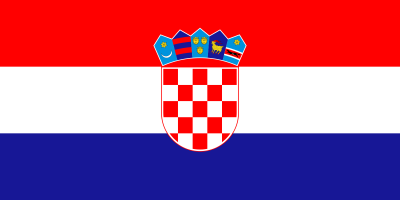
Known officially as the Republic of Croatia, Croatia is a country in Central Europe, bordered by Slovenia, Hungary, Serbia, Bosnia and Herzegovina, Montenegro and the Adriatic Sea. The nation is known for its long, scenic coastline with over a thousand islands, clear blue waters, and well-preserved historic towns. Croatia has a diverse landscape that includes mountains, plains, forests, and beaches, as well as several national parks such as Plitvice Lakes, which is famous for its waterfalls and turquoise lakes. It also has a rich cultural heritage shaped by Roman, medieval, Venetian, and Austro-Hungarian influences.
The country's capital is Zagreb, located in the northwest. It is the political, economic, and cultural centre of Croatia, combining an old historic old with modern urban life. The city features museums, theatres, universities and lively cafés, and it's known for its Austro-Hungarian architecture, green parks and vibrant cultural scene. Also, unlike Croatia’s coastal cities, Zagreb has a continental climate with warm summers and cold winters.
Earthquakes, floods and landslides. Forest fires are common from June to September.
Fines are usually issued and collected on-the-spot in Croatia. Tourists that leave Croatia without paying a fine can lead authorities may pursue the fine through cross-border cooperation, and to prosecution if returned to the country and not paid up. Traffic offences can also implement points, where accumulating 9 within a 3-year period results in a 12-month driving ban. Serious offences that earns at least 3 points can lead to immediate licence loss.
Examples of traffic/driving offences include the following:
These fines are usually sent to the rental company, which then charges you plus admin fees. Other violations to keep in mind are:
The official language of Croatia is Croatian, and uses the Latin alphabet as its writing system.
Vehicles drive on the right, and overtake on the left. The minimum age to drive is 18, but it is 21 to rent a car. Rental companies with asks drivers if they have held a licence for 1 - 2 years, and/or may charge drivers under 25 extra fees. UK drivers don't usually need an International Driving Permit (IDP) to drive in Croatia unless they have an older paper licence or the rental company they're using requires one. A UK licence is valid for stays up to 6 - 12 months. Afterwards, a Croatian licence is needed.
Roads in Croatia are generally in good condition, though coastal and rural roads may be narrow or winding. Dipped headlights must be used at night and even in the day (especially during winter months) for increased visibility and safety. Croatian motorways (autoceste) are toll roads where you usually take a ticket on entry and pay on exit. Parking in cities often requires payment; fines can be charged to the rental car and passed on to you later, and parking in historic towns (e.g., Dubrovnik) can be tight and pricey, so plan in advance.
The common fuel types in Croatia are Benzin 95/Eurosuper 95 (standard petrol), Benzin 98/Premium (higher octane petrol), Dizel/Eurodiesel (Diesel), and LPG (Autoplin). EV charging is also available, especially in large towns. Both cash and card are widely accepted. Fuel stations are mostly self-service, where some allowing 'pay-at-pump' option with card, though others require payment inside. Additionally, some stations have loyalty programmes or mobile payment options (e.g., Petrol GO app).
Croatia has a wide network of petrol stations, especially in cities, along major roads and on highways — with highway stations open 24/7, and many stations include shops, cafés, toilets and rest areas. However, stations are less frequent in rural areas and on some islands, where local stations in small towns tend to close at night (often around 8pm - 10pm). If you're planning to go on long drives or to the islands, fill up before leaving if possible, and whenever the opportunity rises. Also, when driving in a rental, return with a full tank to avoid extra charges. Rental cars are usually filled with info stickers showing the correct fuel type.
The legal limit is 0.05%; 0.00% (zero-tolerance) for drivers under 25.
Seatbelts are compulsory for all passengers.
Children under 12 must sit in the back and must use an appropriate child seat.
Check out more of our Country Guides: