
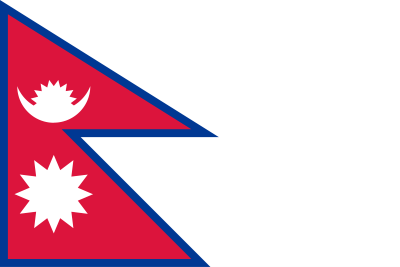
Officially dubbed as the Federal Democratic Republic of Nepal, Nepal is is a landlocked country in South Asia, mainly situated in the Himalayas, and bordered between China and India. It is known for its dramatic landscapes ranging from fertile plains in the south to the towering Himalayan mountains in the north. Nepal is also home to Mount Everest; the world’s highest peak, as well as a rich cultural heritage shaped by Hinduism, Buddhism, and numerous ethnic groups. Its capital, Kathmandu, is the largest city in Nepal. Located in the Kathmandu Valley, the city is known as the 'City of Temples'; home to famous landmarks like the Pashupatinath Temple, Swayambhunath (Monkey Temple), and Durbar Square. It serves as the cultural, economic, and political heart of the country.
Earthquakes, frequent landslides and floods triggered by intense monsoon rains.
Most traffic fines are issued on the spot by traffic police; many can also be paid through apps like the Nagarik e-challan system. Common violations under the current enforcement regime are as follow;
Repeated violations often carry higher fines or require awareness classes. In big cities like Kathmandu, additional local fines (e.g., for parking violations) can be much higher — sometimes up to रु50,000 (~£257) for specific urban infractions.
Other violations include:
The official language of Nepal is Nepali, but Maithili, Bhojpuri, Tharu and Newari are also spoken.
Vehicles drive on the left side in Nepal. The minimum age to drive is 18, but drivers need to be at least 21 to rent, where some rental companies would charge a 'young driver' fee to those under 25. UK drivers need a 1968 International Driving Permit (IDP), alongside their UK licence, to drive legally in the country — the 1949 version is no longer available.
Road conditions can vary widely in Nepal — from good sealed highways to rough mountain tracks, and can be dangerous due to poor signage, unmarked hazards and mixed traffic (vehicles, pedestrians, animals).
Standard petrol (91 - 92 RON) and diesel are generally available in Nepalese fuel stations, where EV charging is limited outside urban areas, and high-octane/premium petrol is typically not available across Nepal — so avoid vehicles that require premium petrol. Stations are widely available in major highways and district centres (either open 6am - 9pm, or 24/7), but stations can be very far apart in rural areas, with them selling fuel in bottles and/or plastic containers that may not be in good condition. So, only buy them in emergencies. Cash is universally accepted, where card is rarely accepted (mainly in some cities, but unreliable), and stations are generally full-service, but make sure the meter has been reset to zero, pay after fuelling, and ask for a receipt if available.
The speed limits for rural areas and highways are applied to cars and motorbikes.
Zero-tolerance policy (known locally as MaPaSe).
Mandatory for all occupants.
There are no specific, legally enforced regulations requiring child restraint systems, but it is recommended to have children under 12 or under 135cm to be assigned to a child seat, and to only be at the back seats.